Portfolio, the members’ newsletter of the Norman Rockwell Museum, has been published regularly since 1984. The newsletters contain informative and entertaining articles about Norman Rockwell, American illustration, exhibitions and museum happenings. Articles are written by authoritative sources including Norman Rockwell Museum curators and outside scholars. Illustrators whose work has been detailed in Portfolio include Rockwell Kent, Charles Schultz, Winslow Homer and J.C. Leyendecker.

- 1980s Portfolios
- Winter 1984 Norman Rockwell Remembered
Call this an exercise in reminiscence. Think of it as calling from memory half-forgotten moments, incidents, conversations. It has been more than five years now, five years since the death. - Summer 1984 Curator’s Corner, by Laurie Norton Moffatt
After observing several years of enthusiastic reception by our visitors, Norman Rockwell formally entrusted his personal collection of art to the Old Corner House in 1973, creating what would henceforth be known as the ‘Norman Rockwell Art Collection Trust’. - Winter 1985 Linwood, Charles Butler Estate, to Be Home of New Rockwell Museum
Linwood, the estate recently acquired by the Norman Rockwell Museum at the Old Corner House, is a forty-acre property located in the Glendale section of Stockbridge. - Summer 1985 “Lost” Rockwell Painting Returns
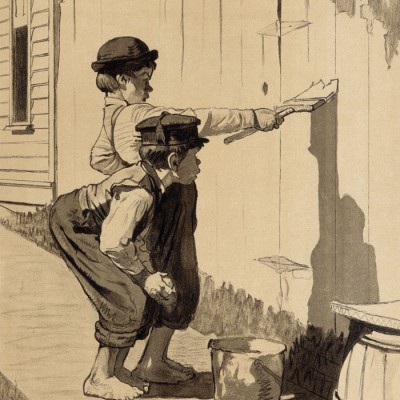
Recently the William A. Farnsworth Library and Art Museum in Rockland, Maine, received as a bequest a Rockwell painting which this Museum quickly identified as an oil, itT om Sawyer Whitewashes the Fence,” painted by Rockwell in 1936 for the Heritage Club Edition of Mark Twain’s classic. - Winter 1986 Curator’s Corner, by Laurie Norton Moffatt
The Norman Rockwell Museum at Stockbridge continued to build its strong collection of original works with several exciting acquisitions in 1985. - Summer 1986 Curator’s Corner, by Laurie Norton Moffatt
Norman Rockwell’s early advertisements reveal not only a younger artist at work, but also a younger age in advertising than we know today. - Winter 1987 Curator’s Corner, by Laurie Norton Moffatt
Norman Rockwell touched the lives of the ordinary and the famous, and, though famous in his own right, was not immune to a case of the jitters when faced with the prospect of meeting America’s greatest citizens. - Summer 1987 Rockwell’s Private Collection on Exhibit
A significant portion of Norman Rockwell’s private art collection, never before seen by the public, is on exhibit at the Museum.
Curator’s Corner: Aunt Ella Takes a Trip, by Roger Reed
One of the pinnacles of Norman Rockwell’s career was his series of fiction illustrations from the ’30s and ’40s. - Autumn 1987 An Amazing Story: The Spielberg/Warner Communications Gift
Steven Spielberg, the renowned film producer and director, in conjunction with Warner Communications, Inc., has made a major donation to the capital campaign. - Spring 1988 Robert A. M. Stern Wins Museum Gallery Competition
the firm of Robert A. M. Stern Architects of New York is the winner of the limited invitational competition conducted by the Museum to select the designer of the new gallery building.
Curator’s Corner, by Maureen Hart Hennessey
This country’s bicentennial was celebrated in a variety of ways in 1976, all distinctly American. - Summer-Autumn 1988 She Came for a Visit and Stayed 16 Years
Margaret and John Batty had just retired from their jobs in St. Louis a year earlier, when they came to the Berkshires to relax and spend Christmas with their son in 1972.
Curator’s Corner, by Maureen Hart Hennessey
Norman Rockwell’s use of friends and neighbors as models for his paintings is a well-known aspect of the illustrator’s work
Unexpected Treasures Found in Photo Archives, by Barbara Perkel
When Norman Rockwell’s studio was moved from his property in the center of Stockbridge to Linwood, his files of photographs were put into boxes and placed in storage with the hope that they would provide some surprises for the Museum. - Winter 1989 Curator’s Corner, by Maureen Hart Hennessey
Norman Rockwell’s paintings and drawings show the artistry and technical skill of Rockwell the illustrator. But, sometimes, Rockwell’s art allows us a glimpse of Norman Rockwell the man. - Spring 1989 Museum Exhibition Focuses on Rockwell Images of Blacks
One Nation Indivisible? Images of Black Americans: 1934-1967 By Norman Rockwell, an exhibition of Rockwell paintings, studies, tear sheets, and photographs that focus on the black American experience, dispels a commonly-held belief that Norman Rockwell was an illustrator of white middle-class life and nothing more.
Rockwell Museum Turns Twenty!
June 1, 1989 marks the twentieth year of operation of The Norman Rockwell Museum at Stockbridge.
Curator’s Corner, by Maureen Hart Hennessey
In the fall of 1912, Norman Rockwell received his first commission from the Boy Scouts of America. - Summer 1989 Curator’s Corner, by Maureen Hart Hennessey
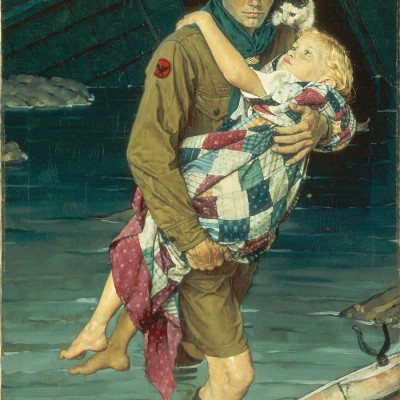
Norman Rockwell’s 64-year association with the Boy Scouts of America resulted in some of his best-known illustrations – those of young Scouts in action, done for the Boy Scouts’ calendar. - Winter 1989 Hallmark Loans Holiday Pieces for Special Exhibition
Season’s Greetings From Norman Rockwell: Holiday Images from Hallmark Cards, a special exhibition of 11 original Rockwell paintings and two preliminary works commissioned by Hallmark Cards for its Christmas card series, brightened the holidays for museum visitors …
Curator’s Corner, by Maureen Hart Hennessey
Of the more than 800 images Norman Rockwell created for advertising and commercial uses, the Christmas card illustrations produced for Hallmark Cards, Inc., rank among the most popular and well known.
- Winter 1984 Norman Rockwell Remembered
- 1990-1994 Portfolios
- Spring 1990 Curator’s Corner, by Maureen Hart Hennessey
American museums have relied, throughout this century, on the generosity of individual and corporate donors who have supported a variety of programs-from exhibitions, to capital drives, to endowments - Summer 1990 Curator’s Corner, by Maureen Hart Hennessey
During World War II, as American men left to fight in Europe and the Pacific, American women came forward to fill the vacancies. - Autumn 1990 Fitzpatricks Donate $250,000 to Museum
The board of trustees of The Norman Rockwell Museum is pleased to announce that a gallery in the new museum will be named for Senator and Mrs.John H. Fitzpatrick in honor of their contributions to the new facility, which total $250,000.
Curator’s Corner, by Maureen Hart Hennessey
When planning an exhibit, it is frequently difficult to decide what to include and what to leave out. - Spring 1991 Curator’s Corner, by Linda Szekely
Norman Rockwell’s painting for The Magic Foot-Ball, a children’s story by Ralph Henry Barbour, appeared in St. Nicholas magazine in 1914. - Summer 1991 Macaulay on Rockwell
When David Macaulay was a young lad, he dreamed of being an artist. Sometimes, after looking at a Rockwell Saturday Evening Post cover or two, he even experimented with the signature he would use on his work one day … when he was famous. That signature bore a striking resemblance to Rockwell’s. - Autumn 1991 Curator’s Corner, by Maureen Hart Hennessey
As a chronicler of American history, Norman Rockwell is best known for his illustrations of ordinary people in everyday situations. At the same time, he was in a unique position to portray major events in twentieth-century America and the people who helped shape our world. - Spring 1992 Curator’s Corner, by Maureen Hart Hennessey
Norman Rockwell’s process for creating an illustration followed several steps, from the development of an idea through the final painting. One important component was the final charcoal or pencil drawing.
Bill Langley: Rockwell Admirer and Illustrator
Often working under tight deadlines, he spends hours in his studio creating illustrations. He is meticulous, completing many preparatory steps before embarking on a finished color piece. - Summer 1992 Museum Gathers Rockwell Recollections As Part Of Homecoming Year Celebration
Over the past nine months, museum staff gathered firsthand remembrances from people who knew Norman Rockwell.
Curator’s Corner, by Maureen Hart Hennessey
One important step in Norman Rockwell’s process for creating an illustration was the color study. - Autumn 1992 Artyfacts, by Kim Conley
The proliferation of tales with a medieval theme is one example of legendary storytelling which resonates throughout Western literature. Norman Rockwell was not unaffected by medieval archetypes.
Rockwell’s Political Portraits, by Jim Farr
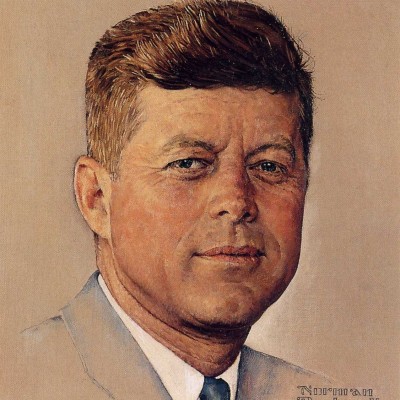
Between 1952 and 1972, Norman Rockwell painted every presidential candidate, and an election-year exhibition at the museum features seven of these images.Curator’s Corner, by Maureen Hart Hennessey
In the summer of 1960, Norman Rockwell took a sketch class in the studio of Peggy Worthington Best in Stockbridge. At the time, Rockwell was trying to loosen up his style. In the class, which met weekly to sketch a model, he produced a type of work very different from his usual tight, detailed pictures. - Winter 1993
- Spring 1993 A Dream Come True, by Laurie Norton Moffatt
On April 3, 1993, a decade-long dream comes true when the new Norman Rockwell museum opens. With the opening of the doors, the museum will have completed a long
journey-from origins in the charming, but modest, six-room Old Comer House museum to evolution into a full-service 36-acre museum complex.
The Norman Rockwell Museum at Stockbridge: A Brief History
The Norman Rockwell Museum at Stockbridge is one of the few museums in the country to have grown literally out of popular demand.A Peek into Norman Rockwell’s Studio
In keeping with Nonnan Rockwell’s wish that his Stockbridge workplace be preserved for the public, his actual studio has become part of The Norman Rockwell Museum at Stockbridge. In this simple barn, Rockwell created some of his best loved works, including The Triple Self-Portrait and The Runaway.The Architect Reflects, by Robert A.M. Stern
An art museum is a very important building type for architects. A museum is a place of learning, of course, but it is preeminently a place of contemplation; a sacred space, almost, and certainly a place of the heart. - Summer 1993 Curator’s Corner, by Maureen Hart Hennesey
Peter Rockwell, Norman Rockwell’s youngest son, is an internationally-known sculptor and teacher who lives in Rome, Italy. His work, both cast in bronze and carved in stone, is in the collections of the National Portrait Gallery, Washington, DC; the National Cathedral in Washington, DC; and the Bridgeport Museum of American Art, Bridgeport, CT.
A Closer Look at Norman Rockwell’s Studio, by Linda Szekely
“Nothing else in the world, not all the armies … is so powerful as an idea whose time has come.” Out of its setting of Norman Rockwell’s studio wall, Victor Hugo’s words have. a universal quality, whether applied to business, politics or the arts. - Autumn 1993 Curator’s Corner, by Maureen Hart Hennesey
Norman Rockwell’s process for creating an illustration included a number of steps as he progressed from getting the initial idea to sending the final oil painting to the editor or other client. For Rockwell, the pencil or charcoal drawing was a critical step in the development of an illustration. - Winter 1994
- Spring 1994 Curator’s Corner, by Maureen Hart Hennesey
Norman Rockwell considered the development of an idea for a cover story as probably the most important element of an illustration, and coming up with fresh ideas was one of the hardest parts of his work.
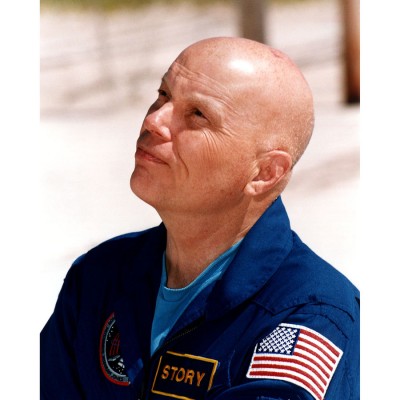
An Astronaut & The Norman Rockwell Museum, by Bea Snyder
It is not because Story Musgrave is the veteran of five shuttle missions that hundreds of thousands of people make a pilgrimage each year to the former dairy farm in Stockbridge
where he spent his boyhood. It is because Linwood farm is now home to T he Norman Rockwell Museum at Stockbridge. - Summer 1994 Curator’s Corner, by Maureen Hart Hennesey
On January 24, 1994, The James Beard Foundation presented the Portrait of Felipe Rojas-Lombardi to The Norman Rockwell Museum. Although Norman Rockwell did not consider himself a portraitist, he was a master at capturing the expressions and emotions
of his characters.
Howard Pyle and Norman Rockwell – Lasting Legacies, by Maureen Hart Hennessey
Howard Pyle (1853-1911) and Norman Rockwell (1894-1978) represent the best in American illustration, and were the most popular illustrators of their respective generations. Howard Pyle is considered to be “the father of American illustration,” and he directly influenced a generation of illustrators. - Autumn 1994 Curator’s Corner, by Maureen Hart Hennesey
While Norman Rockwell is best known for his magazine cover illustrations, advertising and other commercial art comprise the largest category of illustration work Rockwell created. During his long career, Rockwell worked for over 150 companies, and produced more than 800 advertisements, calendar illustrations, logos and mastheads.
Art and World War II, by Philip B. Meggs
One can identify a society’s major concerns from its communication art. The raison d’etre of communication art is to convey messages within a culture. This is in contrast to those works whose primary purpose is decoration or personal expression by the artist.Monsters are Emerging, by Cris Raymond
From the Swat Valley of Pakistan, where he was examining archeological digs for the Italian Institute for Near and Far Eastern Studies, and via Rome, Italy where he lives, Peter Rockwell arrived in Stockbridge with all the tools one needs to begin work on carving monsters out of an eight-foot high, 5 1/2 ton piece of Indiana limestone.
- Spring 1990 Curator’s Corner, by Maureen Hart Hennessey
- 1995-1999 Portfolios
- Winter 1995
- Spring 1995 Molly Punderson Rockwell, by Linda Szekely
Mary (Molly) Punderson was born in Stockbridge in 1896. She graduated from Williams High School and Radcliffe College, and, in 1921, joined Milton Academy where she taught English until her retirement in 1959.
Molly met Norman Rockwell while teaching a poetry class at the Lenox Library in 1961.
A Centennial Celebration- Hometown USA, by Maureen Hart Hennesey
Norman Rockwell’s gift for portraying individuals and their relationships to their families, their communities, and the world around them is explored throughout the exhibition, A Centennial Celebration. - Summer 1995 Building an Art Collection, by Laurie Norton Moffatt
One of the most exciting moments for a museum director is adding more art to the collection! Museums celebrate the arrival of new paintings, objects, and photographs. They relate the story of our lives, and who better to tell the story of 20th-century America than Norman Rockwell? Norman Rockwell was the museum’s first art donor.
Curator’s Corner, by Maureen Hart Hennesey
The Norman Rockwell Museum is pleased to announce its newest acquisition, a color study for the March 17, 1945 Saturday Evening Post cover, Income Tax. The oil on photograph on board depicts a harried taxpayer, seen from behind, as he attempts to make the March 15, 1945 income tax deadline. The study is markedly different from the fmal Post cover.A Centennial Celebration-On The Twentieth Century, by Maureen Hart Hennessey,
Norman Rockwell is perhaps best known for his images of friendly small towns and family scenes. At the same time, Rockwell, as the premier illustrator of his age, was also in a unique position to cover me significant events in twentieth-century America and the people who helped shape the nation and the world. - Autumn 1995 The Art of Enchantment, by Stephanie H. Plunkett
“Now the great thing about illustrating a classic is that it is alive. When you read it the scenes-character, setting, mood-jump right off the page, metamorphosed into pictures which are complete and perfect to the last detail…”
Maxfield Parrish, by Linda Szekely
Maxfield Parrish, 1870-1966, was one of the most prominent and successful illustrators of the Golden Age of Illustration. This era, 1880 to 1920, was an age of mass-market printed media.Tom Sawyer Tells a Story
When Norman Rockwell was invited in 1935 to illustrate the children’s classic Tom Sawyer, he went where no other Mark Twain illustrator had gone before-to Hannibal, Missouri. Norman wanted to capture the authentic details of Mark Twain’s boyhood town. - Spring 1996 Norman Rockwell’s World of Scouting, by Maureen Hart Hennessey
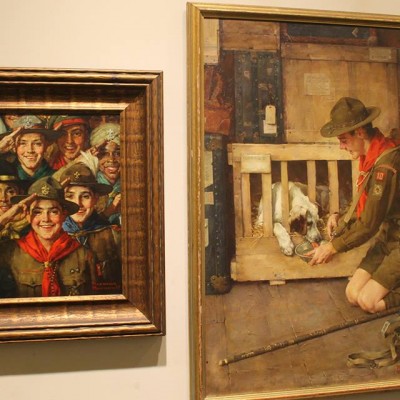
While it is true that Norman Rockwell is perhaps best known for his covers for The Saturday Evening Post, his calendar illustrations and other work for the Boy Scouts of America are almost as popular.
Curator’s Corner, by Maureen Hart Hennessey
In 1914, when Norman Rockwell was just twenty years old and building a reputation as an illustrator for children’s and young people’s publications, he completed illustrations for three works appearing in serial form for Boys’ Life, the national magazine of the Boy Scouts of America. - Summer 1996 A Magazine and Its Covers, by Jan Cohn
For over six decades, the Saturday Evening Post was one of America’s most popular magazines. Even today, older readers recall favorite writers, stories, and characters.
Rockwell Paints the Candidates, by Bea Snyder
Although Norman Rockwell never did run for President, he did come in close contact with presidents and presidential candidates from 1952 to 1972, when he was commissioned to paint their portraits.Curator’s Corner, by Maureen Hart Hennessey
The Runaway is one of Norman Rockwell’s best known and most popular works. The young adventurer with his worldly treasures tied up in a bandana, the concerned state trooper, and the slightly world weary, amused counter clerk appear in what many consider tile quintessential runaway scene. - Autumn 1996 The International Reach of Norman Rockwell, by Laurie Norton Moffatt
Norman Rockwell may be America’s most beloved illustrator, but his reputation is spreading around the globe. The widespread interest in and the appreciation of the universal human emotions and family moments depicted in Rockwell’s work make his paintings an American ambassador to the world.
Growing Up with Dick and Jane: Learning and Living the American Dream, by Carole Kismaric and Marvin Heiferman
At the turn of the century, American textbooks were heavy with words. Excerpts from literature or Bible stories preached moralistic values, mainly without the help of illustrations. William Gray, one of the nation’s leading reading experts, was looking for a better way to teach children to read.The Picturebook Art of Chihiro Iwasaki, by Ann Keay Beneduce
Chihiro Iwasaki’s sensitive interpretations of childhood are as admired and beloved in her native Japan as Norman Rockwell’s depictions of American life are in the United States. Though they may seem diametrically opposed, the works of these two artists are similar in many respects. Both artists chose to work in the field of illustration and displayed exceptional ability and dazzling technique within their chosen mediums and range.Bill Scovill 1915-1996: Rockwell Photographer, Dear Friend, by Linda Szekely
On the north wall of Norman Rockwell’s studio, there is a photo of Bill Scovill among the family snapshots. The only other photo of a non-family member is of Louie Lamone,
Rockwell’s assistant of 23 years. Unframed and cropped from its original context, the significance of Bill’s picture is not immediately apparent. However, behind
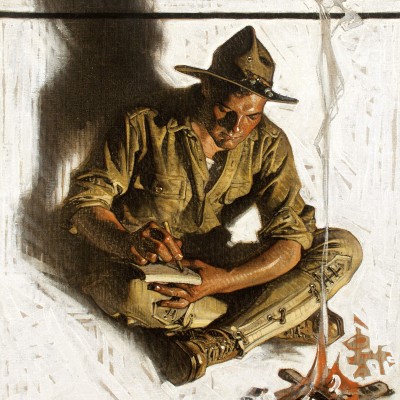
this small snapshot lies ten years of experiences between an artist and his photographer. - Winter 1997-98 J. C. Leyendecker and Norman Rockwell, by Maureen Hart Hennessey
Norman Rockwell considered J.C. Leyendecker (1874-1951) as one of America’s greatest illustrators and a personal hero. - Spring 1997 Going Once, Going Twice, SOLD!, by Laurie Norton Moffatt

To bidder number 301! Attending an auction is a thrill, a fast-paced drama where art revolves around the center stage, people revolve in and out the gallery door, and paddles, hands, and heads nod or nay at each incremental stage of the auctioneer’s bidding.
My Father’s Paintings About Painting, by Peter Rockwell
From the point of view of both the general public and the art world, one was either for or against abstract art. Flowing from this dualism was the characterization of the two sides as populist versus elitist, anti-intellectual versus intellectual and finally uneducated versus educated.Curator’s Corner: Phil the Fiddler, by Linda Szekely
In the 1930s, Norman Rockwell was commissioned by Heritage Press, a division of George Macy Companies, to illustrate Tom Sawyer and Huckleberry Finn. From this very successful and profitable venture, a personal relationship developed between Rockwell and George Macy that led to proposals for additional book projects. - Summer 1997 Family Ties: Rockwell’s Art for Family, Friends and Fun, by Maureen Hart Hennessey
During a career that spanned seven decades, Norman Rockwell was extremely prolific, creating over 2,600 published illustrations and the many color and charcoal studies used to develop these final images. Relatively few Rockwell works were noncommissioned; even portraits of his family members and friends were sometimes done as illustrations for publication.
Silent Wonder: The Paintings of Wendell Minor, by Stephanie Plunkett and JoAnn Losinger
A gifted American painter, illustrator and graphic designer, Wendell Minor is known as a traditionalist and a romantic.Curator’s Corner: Bill Scovill’s Bequest, by Maureen Hart Hennessey
Norman Rockwell’s working methods often have been the focus of this column, especially when a new study enters the museum’s collection. From the earliest conceptual sketch and photographs of carefully selected models and settings, through the detailed charcoal drawing and loosely painted color study, to the final oil painting and the printed illustration, every piece represents an important part of the overall process that Rockwell developed to create his illustrations. - Winter 1998-99 From Idea to Illustration, by Cris Raymond
The exhibition Visual Solutions is an exciting and informative look into the working process of seven illustrators. It demonstrates the process from the moment a commission is received to the final point when the artist sees his work published. We asked the seven illustrators to describe that quantum leap from idea to illustration. - Spring 1998 Changes and Challenges: Rockwell in the 1930s, by Maureen Hart Hennessey
The 1930s were a time of crisis and uncertainty in America. The collapse of the U.S. Stock Exchange on October 28, 1929 created a world economic crisis that reverberated through most of the coming decade. Tensions in Europe would explode into war by September 1939.
A Move to the Country: Rockwell in Westchester, by Stephanie Plunkett
Although his images often betray a heartfelt appreciation for rural life, it gave Norman Rockwell considerable pleasure to let people know that he actually had been born in New York City, where he and his family lived in a fifth floor walk-up on 103rd Street and Amsterdam Avenue. - Summer 1998 Winslow Homer: Artist & Illustrator, by Wendy Lutz
Winslow Homer occupies a coveted place in the pantheon of American art. A prolific artist of remarkable versatility, Homer’s work spans over half a century.
A Cultural Exploration of The Saturday Evening Post, by Christopher Clarke-Hazlett, PhD.
It’s easy to forget that for much of the 20th century, the Post came into American homes that had no TV sets or other similar visual distractions. - Autumn 1998 Footlights and Fireflies Summer Theater as Seen by Hirschfeld, by David Leopold
Long after the curtain has fallen and the last ovation has subsided, the lasting image of the performance is often the one created not by the performers, but by Al Hirschfeld who has captured, with the aid of India ink and illustration board, the worlds of theater, film, dance, music, literature, and politics for almost the entire century.
Studio Artifact Tells a Story of Peace Corps Travels, by Linda Szekely
In a darkened corner of the west wall balcony of Norman Rockwell’s studio resides a mysterious looking object. In earthy organic colors and substances, it occupies a cloistered but esteemed position on the balcony’s railing.Visual Solutions, by Michelle Gillett
Visual Solutions: Seven Illustrators and the Creative Process is much more than an exhibition of artists’ works. This visual dialogue tells how and where artists get their ideas and bring them to life - Spring 1999 Hooray for Rockwell’s Hollywood, by Linda Szekely
Since Norman Rockwell was best-known for his magazine covers, people are surprised to hear that he also illustrated movie posters.
Jarvis Rockwell’s World, by Cris Raymond
For twenty years, Jarvis Rockwell has been collecting small plastic toys and creating a whole new world of art with them. These figures, popular in every country, have become symbols of our times. - Summer 1999 Drew Struzan – Hollywood’s Illustrator, by Cris Raymond
Illustration art encompasses many formats. Books, advertisements, corporate logos, limited edition prints, CD covers and many other visual displays impress images on the minds of the public.
Perhaps the most fleeting of the thousands of images seen is that of the movie poster. - Autumn 1999 The People’s Painter, by Laurie Norton Moffatt
Norman Rockwell was the people’s artist. The public adored the work of this skilled storyteller. Rockwell received bagfuls of fan mail that applauded his finely honed sense of image-making. While many viewers stared bemused at Jackson Pollock’s dribbled paint and Picasso’s fractured shapes, the people understood Rockwell because he so clearly understood them.
The Saturday Evening Post: What Americans Looked at Before TV, by Christopher Clarke-Hazlett, PhD.
The 20th century has been a visual century. In the decades following 1900, images superseded the written word as the most important form of communication in American culture. They have remained dominant ever since.The Saturday Evening Post: A National Family Magazine, by Maud Ayson
Through most of its history, The Saturday Evening Post was defined as a national family magazine that lauded the virtues of progress and the quest for the “American dream,” while, at the same time, it also evoked a nostalgia for purer, simpler times. By the 1950s, the Post faced the increasing challenges of photo journalism, special-niche publications and the appeal of television. The magazine that once prided itself on its outstanding illustrations, extraordinary mix of writing and latest brand-name product advertisements found it could no longer capture its audience’s interest.Eye on America: Editorial Illustration in the 1990s, by Stephanie H. Plunkett
Art is a part of its time. If we examine the range of art from any era and geographic location, we are able to gain a greater understanding of the concerns, values and attitudes of a society in its time and place. Throughout the ages, contemporary artists have acted as observers, informers and educators, revealing to the rest of us what was, or is, happening around us.
- 2000 – present Portfolios
- Winter 2000 In Rockwell We Trust, by Linda Szekely
Michael Jordan gobbles down Ball Park franks, Paul Hogan drives his Subaru Outback over rough terrain, Jerry Seinfeld charges with American Express and country singer Alan Jackson sings the ballad of the Ford truck.
The Post Boys, by Jan Cohn
The Post boy with a canvas bag slung over his shoulder was a determined lad on his way to earn pocket money for a bike, or perhaps to save his earnings for his education. - Spring 2000 The Girl Rockwell Gave to Disney, by David Verzi
The original oil painting for the Saturday Evening Post cover of March 1, 1941, Girl Reading the Post, stands as a token of respect and friendship between two cultural icons- the 20th-century’s giants of animation and illustration. Norman Rockwell gave the painting to Walt Disney in 1943 during the illustrator’s brief residence in Alhambra, California. Rockwell inscribed the work, “To Walt Disney, one of the really great artists – from an admirer, Norman Rockwell.”
Distant Shores: The Odyssey of Rockwell Kent
Wilderness exploration holds an irresistible attraction for the intrepid. Rockwell Kent (1882-1971) was such an explorer.One Teenager’s View, by Abigal August
Permit me, please, to introduce myself. I am a senior at Miss Hall’s School in Pittsfield, Massachusetts. My school has a program called “Senior Horizons” that enables students to focus on career and personal interests by interning in a community business or organization of our choice once a week for twenty-five afternoons. For my internship, 1 chose the Norman Rockwell Museum. - Summer 2000 The Artist as Abstract Expressionist, by Linda Pero
The world of modern art seemed to be born out of the New York Armory Show of 1917, one year after Rockwell’s debut on the cover of the Saturday Evening Post with Boy with Baby Carriage. A fascination with modern art led Rockwell to Paris in 1932 to study art and experiment with new styles. Upon his return, he was told by Post editor Horace Lorimer to stick to what he did best, the story-telling pictures of middle-American life. - Autumn 2000 Pushing the Envelope: The Art of the Postage Stamp, by Stephanie Plunkett
Despite their small scale and relatively discreet placement on the letters and packages that move throughout lives each day, postage stamps probably have greater communicative power per square inch than any other cultural artifact.
The Spirit of Christmas, by Linda Pero
In this holiday season, visitors to the Norman Rockwell Museum will be treated to Norman Rockwell’s original paintings of scenes for Hallmark Christmas cards. Among the most popular of his works, and still an enduring part of Hallmark’s Christmas line, the twenty-seven paintings from the Hallmark collection of Rockwell artwork were commissioned between 1948 and 1957. - Winter 2001 A Closer Look: The Making of James Gurney’s World of Dinosaurs Stamps, by Stephanie Plunkett
Mysterious and awe-inspiring, the first dinosaurs appeared around 236 million years ago in the Late Triassic period at the same time as crocodiles and turtles. Dinosaurs became extinct 65 million years ago at the end of the Cretaceous period. Their fossilized remains, which were first discovered in the early nineteenth century, offer a fascinating look at the lives of these enigmatic beasts.
A Model Family, by Thomas C. Daly
All of Norman Rockwell’s 322 Saturday Evening Post covers are once again on exhibition at the Norman Rockwell Museum. Having an overview of the complete run of Rockwell’s Post cover art allows the viewer to recognize the recurrent themes that Rockwell painted. - Spring 2001 On Blackening My Father’s Name, by Peter Rockwell
People frequently do not like to have anyone mess with the image of someone they hold dear. I first became aware of this when doing portraits of children.
Designing Small, by Howard E. Paine
A stamp is only a tiny slip of paper, about one square inch in area, with a smudge of color and perhaps four or five typed words. It is framed by a series of perforations that enable this miniature document to be torn from its sheet and stuck in the upper right corner of an envelope. The design of a postage stamp is indeed a tiny task, but print that stamp up to a billion times, send identical copies to over 35,000 post offices and suddenly the design problem is seen in a different light. - 2002 issue 1 Charles Schulz – Master of Simplicity, by Jan Eliot
I first decided to contact Charles Schulz, whom I would later know as “Sparky,” in 1982. I had spent three years developing and publishing my first cartoon strip, Patience and Sarah, which featured a divorced single mom (Patience) and her precocious daughter (Sarah).
Merrie Christmas, by Linda Pero
The museum has been fortunate to receive a gift of an original 1929 Saturday Evening Post cover painting from the family of John W. Hanes of Virginia and New York. The 44 x 33-inch oil on canvas is an important example of the sub-genre of Dickensian motifs that Rockwell repeatedly explored and revisited over the course of his long illustration career.Reintroducing Norman Rockwell, by Robert Rosenblum
Norman Rockwell keeps pricking my art-historical conscience. First, there was the Wadsworth Atheneum, in 1985, where, to my disbelief, I saw hanging, right in the midst of Picasso, Mondrian, and Miro, a picture of a spunky little girl, smiling proudly over her newly acquired black eye as she waits outside the principal’s office for her comeuppance.Art and Patriotism, by Deborah Solomon
Patriotic art has never exactly ranked high on the list of aesthetic wonders, but who can doubt its appeal? It is hard to think of a painting in an American museum that can compete for visual immediacy with that famous image of Uncle Sam pointing his finger and sternly admonishing, “I Want You.” - 2002 issue 2 John Held Jr. – Irreverent Chronicler of the Jazz Age, by Walt Reed
John Held, Jr. (1889-1958) was a complete artist with talents in many directions, all of which he employed at various times in his long career.
Toast of the Town, by Maureen Hart Hennessey
Known as the Queen City of the Sound, New Rochelle, New York, a northern suburb of New York City, was one of America’s most popular enclaves for illustrators during the early twentieth century. Commuter trains to Grand Central Station, just 16 miles away, provided easy access to New York City, the country’s primary center of publishing. With its sophisticated social and cultural milieu, many prominent artists and illustrators were inspired to become a part of New Rochelle’s vibrant community.Can Computers Really Make Art, by Steve Buchanan
The creation of art has always been an exercise of technology that realizes the artist’s vision. We frequently lose sight of that fact because so many of our artistic icons, from old-master paintings to the work of the great twentieth-century illustrators, used tools that had not changed much for generations-pencils, charcoal, oil paint or watercolor.Behind the Scenes of an Exhibition, by Cris Raymond
Museum exhibitions can enthrall us, soothe us and sometimes even overwhelm us with their beauty and richness. Creating such an experience is the product of long and careful planning, and very few people understand the level of work involved in assembling a show at a museum. Here is an abbreviated glimpse of what goes on behind the scenes of an exhibition. - Spring 2003 Norman Rockwell, Year by Year: 1912, by Linda Pero
1912 was full of change and new beginnings for Norman Rockwell. Tackling his assignments with the dedication that earned him the nickname “the Deacon,” Rockwell became one of the most promising students at the Art Students League.
How Bare Walls Turned Into A Bear Exhibition, by David Leopold
As an independent curator, I have had the good fortune to work with institutions around the country on exhibitions that cover a wide range of subjects. From playwright George S. Kaufman to painter, printmaker, and provocateur Rockwell Kent, the one thing they all have in common is that no two shows have come about in the same way.Laurie Norton Moffatt: 25 Years of Dedicated Vision, by Lila W. Berle
Fifteen years before the new Museum building opened, and five years before the Linwood property was acquired, Laurie Norton began her odyssey with the life and work of Norman Rockwell. She started her career with the Norman Rockwell Museum as a guide at the Old Corner House during the summer of 1977, following a junior year at Williams College.Reminiscences on Construction of the New Norman Rockwell Museum, by Paul W. Ivory
I fondly remember the efforts of so many to bring this great Museum and collection to a sorely needed new home. In 1983, the Museum, then housed at the Old Corner House (the first home of the Norman Rockwell Museum), purchased Linwood, a beautiful 36-acre estate in Glendale for the new Museum site.Breathing Life into the New Museum, 1993 – 2003, by Laurie Norton Moffatt
Designing and building the new Norman Rockwell Museum was an exhilarating and unforgettable experience. The sense of pride and accomplishment felt by each person involved resonated throughout every nook and cranny of the beautiful new Museum. - Summer 2003 Norman Rockwell, Year by Year: 1942, by Linda Pero
Vermont living, aside from an occasional Grange Hall square dance or town meeting,
provided few distractions for a work-centered artist such as Norn1an Rockwell. Few social or professional expectations, aside from the pleasurable evening cocktail hour with his Saturday Evening Post colleagues, Mead Schaeffer and Jack Atherton, dissuaded him from time at his easel. The relative solitude along with winter’s cold and shortened daylight hours eventually urged Rockwell and his family to find diversions.
Freedom: Norman Rockwell’s Vermont Years, by Linda Pero
The artwork and artifacts featured in this summer’s special exhibition, Freedom: Nonnan Rockwell’s Vem10nt Years, trace the life and work of Rockwell from 1938, when he first traveled to Vermont in search of a summer home, to 1953, when he moved to Stockbridge, Massachusetts.Drawing Inspiration: Top Illustrators Describe Favorite Rockwell Paintings, by Jeremy Clowe
The first meeting of the Norman Rockwell Museum’s Illustrators Advisory, a talented group composed of the nation’s leading artists in the illustration field, was held in January. The illustrators plan to meet annually at the Museum to discuss a variety of subjects relating to the art and business of illustration, the Museum and its programs. We asked each illustrator on the council to tell us “what is your favorite Norman Rockwell painting and why?” - Autumn 2003
- Autumn 2004 Building Books: The Art of David Macaulay A Conversation with the Artist, by Stephanie Haboush Plunkett
An author and artist who has helped us to understand the working and origins of everything from simple gadgets to elaborate architectural structures, David Macaulay has an extraordinary gift for conveying complex concepts for the printed page within a social and historical context.
Norman Rockwell, Year by Year: 1968, by Linda Szekely Pero
The first day of the New Year began as it usually did for Norman Rockwell. He spent it in his studio hard at work on his latest painting. He did not make a New Year’s resolution as he had the prior January 1, when he wrote, “Resolution – take no job I do not want to paint.” Nor did he renew this earlier vow, which might have saved him some angst before - Summer 2005 Rockwell’s New York, by Linda Szekely Pero
Although Norman Rockwell was born in New York City and lived in or near the city for the first 45 years of his life, only 11 of his 2,900 finished works picture New York. Being a generalist was a good idea for someone whose work needed to be relevant to as many people as possible.
The Art of the New Yorker: Eighty Years in the Vanguard
An Interview with New Yorker Art Editor, Francoise Mouly by Curator of Illustration Art, Stephanie Haboush Plunkett
It has been my pleasure, during the past 18 months, to have had the opportunity to work with gifted art editor Francoise Mouly on the development of The Art of The New Yorker: Eighty Years in the Vanguard. - Autumn – Winter 2006 Norman Rockwell, Year by Year: 1965, by Linda Szekely Pero
In 1965, two years after leaving The Saturday Evening Post as their most popular cover artist, Norman Rockwell, 71, was busy as ever. The Skippy Peanut Butter ads he had done for the 1963 Best Foods “Whispering Sweepstakes” had produced a winner. The prize was an original Rockwell portrait of the winner, and the winner turned out to be a family of five – more than Rockwell had bargained for.
A Rockwell Rediscovered – The Tale of Two Paintings
On April 6, 2006, Norman Rockwell Museum held a press conference to announce that a real-life art mystery had been solved. An iconic Norman Rockwell painting, not previously known to have been missing, had been found. The painting, Breaking Home Ties, first appeared on the September 25, 1954 cover of The Saturday Evening Post. - Winter-Spring 2006 From the Director, Laurie Norton Moffatt
It gives me enormous pleasure to announce the launch of a major new project at the Norman Rockwell Museum that will transform the accessibility of our Museum collections; advance research and understanding of Norman Rockwell’s work; preserve a unique archive of an important American artist; and link the Museum to major research centers and scholars around the world. This project has been recognized as a national model in archival and collections management.
Norman Rockwell, Year by Year: 1966, by Linda Szekely Pero
On January 4,1966, Los Angelenos were treated to an exhibition of 96 paintings and drawings by Norman Rockwell. Inspired by a small promotional display of Rockwell artwork for the upcoming movie Stagecoach, city officials mounted the exhibition at The Municipal Art Gallery at Barnsdall Park.ProjectNORMAN, by Laurie Norton Moffatt
Project NORMAN is one of the most important initiatives the Museum has undertaken. As caretakers of Norman Rockwell’s papers and archives, the Museum manages an extraordinary array of information about the artist, his life, art, models, and the publications for which he worked. Filled with fascinating information, the more than
100,000-i tem-collection reveals insights into 20th-century America, as well as important documentation on Norman Rockwell’s work.ProjectNORMAN Case Study, by Linda Szekely Pero
2001: A Space Odyssey had Hal. The Norman Rockwell Museum has Vernon, a software program selected to organize our art and archival collections. One sample of an image whose artwork, ephemera, and references are accessible through Vernon, is Murder in Mississippi, chosen because of its variety of archival material.Meet ProjectNORMAN’s Vernon, by Martin Mahoney
In the spring of 2005 the Norman Rockwell Museum invested in a unique and powerful tool that will enable us to gain physical and intellectual control of the archival, material culture and art collections housed here.As part of the ProjectNORMAN initiative, the Museum purchased Vernon collections management software. This software will give the Museum and the curatorial staff the ability to compile all of the information throughout the Museum into one central and easily accessible location. - Summer 2007 Ephemeral Beauty: Al Parker and the American Women’s Magazine, 1940-1960, by Stephanie Haboush Plunkett
A founder of the modern glamour aesthetic, Alfred Charles Parker (1906-1985), defined the progressive look and feel of published imagery at a time of sweeping change, when Americans, emerging from the trials of economic depression and war, sought symbols of hope and redemption on the pages of our nation’s periodicals. His innovative modernist artworks created for mass-appeal women’s magazines and their advertisers captivated upwardly mobile mid-twentieth century readers, reflecting and profoundly influencing the values and aspirations of American women and their families during the post-war era.
The Cold Facts: Preserving the Museum’s Photographic Negative Collection, by Corry Kanzenberg
The Norman Rockwell Museum is home to more than 18,000 acetate-based photographic negatives, most of which are reference images Norman Rockwell used in his illustrations. Many images in the negative collection have never been published, and are rarely seen by the public. - Summer 2008 Capturing Stockbridge, by Linda Szekely Pero
Without deliberately intending to do so, Norman Rockwell spent the last 25 years of his life chronicling the people and places of Stockbridge, Massachusetts. When Rockwell moved to Stockbridge in 1953, he immediately began hiring town residents to pose for his commissions. The treasure of images and records that document posing sessions resides within the archives of the Norman Rockwell Museum.
Raw Nerve! The Political Art of Steve Brodner, by Charles Sable
Explosive is an apt term that describes the art of Steve Brodner, whose deftly executed drawings cast a spotlight on the American political scene as it unfolds before us. Working on a national political stage for The New York Times, The New Yorker, Rolling Stone, The Nation, and Newsweek, Brodner is one of the most successful, influential, and widely read of today’s political illustrators.Over the Top: The Illustrated Posters of World War I, by Stephanie Haboush Plunkett
During the First World War, richly illustrated posters inspiring public support served as a primary mechanism of mass communication. Designed to rally Americans to the cause, they were powerful symbols of our nation’s engagement with four Liberty Loan campaigns, the War Savings Stamp program, the Victory Loan, and the American Red Cross.The Lineman Finds a Permanent Home
Norman Rockwell’s stunning 1948 painting The Lineman was donated to the Norman Rockwell Museum on March 12, 2008, as a special gift from Verizon Communications. - Winter 2009 And the Winner Is … America’s Highest Humanities Honor Bestowed on Norman Rockwell Museum
It was a day for rejoicing. On November 17, Laurie Norton Moffatt, Director/CEO, stepped up onto a platform at the White House and accepted the National Humanities Medal on behalf of Norman Rockwell Museum. President George W. Bush bestowed the honor during a special White House ceremony for arts and humanities medal winners. Norton Moffatt was joined at the ceremony by her daughter, Leigh Moffatt, and colleagues Stephanie Haboush Plunkett, Chief Curator and Deputy Director; Daniel M. Cain, President of the Board of Trustees; and Lila Berle, President Emeritus. - Summer 2009 An American institution: Reflections on turning 40, by Laurie Norton Moffatt
From the very first day I set foot in the Old Corner House in 1977, I knew there was something special about the organization that was to become Norman Rockwell Museum. We did not call ourselves Norman Rockwell Museum then, but it was already apparent that that was how our visitors thought of us and spoke of us, and why they flocked to us.
Stories in pictures: Norman Rockwell and the art of illustration, by Stephanie Haboush Plunkett
Like most creators of art for commerce, Norman Rockwell worked within the realm of both aesthetics and technology. An astute visual storyteller and a masterful painter with a distinct, personal message to convey, Rockwell constructed fictional realities that offered a compelling picture of the life to which many 20thcentury Americans aspired.“The best of America,” At home in Stockbridge, by Linda Szekely Pero
In 1953, Norman Rockwell and his wife Mary relocated from Arlington, Vermont, to Stockbridge, Massachusetts. The small town of 2,100 people provided new faces and new inspirations for such pictures as Family Tree, which traced the lineage of the “all-American boy” from a sixteenth century pirate and his Spanish princess captured on the Caribbean Sea.A time for transition: Norman Rockwell and the 1960s, by Corry Kanzenberg
For Norman Rockwell, 1960 marked the beginning of a decade of change. In August of the previous year, Mary Barstow Rockwell, his wife of 28 years and the mother of his children, unexpectedly passed away after a long struggle with depression. Over the next few years, tensions would arise between Rockwell and The Saturday Evening Post, ultimately ending his production of original work for the magazine. And in a seemingly improbable shift, complex subjects of topical significance became the focus of many Rockwell artworks.Living legacy A personal tribute to the Rockwell family, by Laurie Norton Moffatt
Norman Rockwell’s generosity of spirit was legendary. It was evident in his devotion to his public, his everyday kindnesses, and his quiet philanthropy. He had a penchant for giving away his artwork to the many admirers who visited his studio, as the personal inscriptions on hundreds of studies, drawings, and final canvases attest. - Winter-Spring 2010 To Rockwell With Love: Fan Mail and The Saturday Evening Post, by Jessika Drmacich
Historical records are filled with references to well known people. Not until the 19th century, however, did the concept of celebrity explode in mass media. Unlike many other artists, Norman Rockwell was neither underappreciated nor unknown during his lifetime. As an illustrator for the widely disseminated Saturday Evening Post, he achieved celebrity status early and is still one of the few well-known and broadly loved American artists who worked solely for publication.
The Illustrator and the Camera
Like most creators of art for commerce, Norman Rockwell worked within the realm of both aesthetics and technology. Cameras and projection devices have been in use by artists for centuries, sometimes surreptitiously by those wishing to obscure any technical intervention in their process, and opinion was certainly mixed.Rockwell and the Movies, by Joyce K. Schiller
Storytellers come in all stripes: some merely write the stories; some are tellers of tall tales – raconteurs; and some tell their stories through pictures. Norman Rockwell was a great
storyteller. Norman Rockwell was an illustrator.
Rockwell was always partly focused on the world of the imagination and partly on the visible world around him. What better mix could inspire images of and for the movies? - Summer-Autumn 2010 William Steig: Love & Laughter, by Stephanie Haboush Plunkett
As a child, William Steig (1907-2003) wished that he could run away to sea; and if the Great Depression hadn’t intervened, the acclaimed “King of Cartoons” may have done just that.
- Winter 2000 In Rockwell We Trust, by Linda Szekely